
Twitter Recap:ASOR Annual Meeting
Twitter Recap:ASOR Annual Meeting
A big thanks to everyone who attended and helped make theASOR Annual Meeting an amazing event. We couldn’t have done it without you! Also, to everyone […]

Earlier this year, I wrote a post extolling the virtues of spending several days in San Antonio at a world-class resort attending the presentation of world-class papers by world-class scholars. I said it before and […]

The objects treated in this paper were all excavated in the Ancient Near East at sites that are some 200 km distant one from another. Rather more important might be their diachronic distance – a millennium separates […]
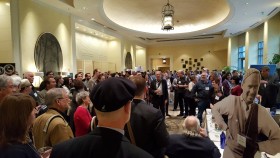
[View the story “#ASOR15 Twitter Recap” on Storify] ~~~ All content provided on this blog is for informational purposes only. The American Schools of Oriental Research (ASOR) makes no representations as to the accuracy or completeness of any information on this blog or found by following any link on this blog. ASOR will not be […]

At theASOR Annual Meeting, several of our members graciously volunteered to have their presentations recorded for ASORtv. Some presenters met with our Digital Media Specialist to read their papers, and some volunteers were recorded in session […]
For the past five years, ASOR has been well guided by the Strategic Plan adopted by its Board of Trustees in April. Indeed, ASOR has achieved many of the goals identified in the Strategic Plan, especially with respect […]

It has been very common for the vast majority of the people in the Greco-Roman world, with the exception of those who lived in the élite urban spheres, to be depicted as a homogeneous mass of “peasants”—members of subsistence-oriented, […]

Are you an ASOR Junior Scholar that is looking for an opportunity to get involved at theASOR Annual Meeting? Do you own a smartphone or have access to a camcorder/camera? Here’s your chance to be a part of the […]

The Umm el-Jimal Project made a thematic shift away from stress on academic archaeological research to site management with twin foci, preservation and community engagement. Site preservation on the ground was complemented […]

Kaman-Kalehöyük is a rural settlement along the ancient Silk Road trade route dating from the Bronze Age (2300 BCE) through the Ottoman Empire. The site is located 100 km southeast of Ankara and 3 km east of Kaman. Excavation has been […]

I introduce one of the many faces of gender represented in the Marlik cemetery in Northern Iran. I suggest the strong possibility of existence of a third gender that was neither a male nor a female in this cemetery. […]
This paper presents the contents of the block as revealed through Reflectance Transformation Imaging (RTI) and digital epigraphy. The author applied these technologies as part of […]

At theASOR Annual Meeting, Darlene Brookes Hedstrom, of Wittenberg University, met with ASORtv to present her paper, “From the Nile to the Desert and Back: Writing a New History of Egyptian Monastic Site Formation.” She first presented her […]

Anyone who has ever been to a conference knows how difficult it can be to eat, let alone fit in all the things you want to do. That’s why we at ASOR are so grateful to all of the volunteers who took time during theASOR Annual Meeting to meet […]

His paper, “Setting the Archaeo-Chemical Record Straight Regarding Tyrian Purple Pigments and Dyes,” was engaging, entertaining, informative, and full of […]

From the Late to Roman Periods (712 BCE–364 CE) through Multispectral Imaging and Technical Analysis. Caroline Roberts was nice enough to volunteer to present her paper for ASORtv. This paper looks at […]

At theASOR Annual Meeting, Jeffrey Zorn of Cornell University presented his paper, “Bin There, Done That: Storage Bins at Tell en-Nasbeh and the Role of the State,” during the Archaeology of […]

At theASOR Annual Meeting, Morag Kersel presented her paper, “Changing Lives: Object Biography and Law.” She did so during the Object Biography for Archaeologists: A Practical Workshop. The workshop was not just about story-telling, […]

In ca. 300 CE, the Roman army built a legionary fortress for the legio VI Ferrata at the site of Udhruh, 15 km east of Petra in southern Jordan. The site’s long history began prior to the construction of the fortress, […]
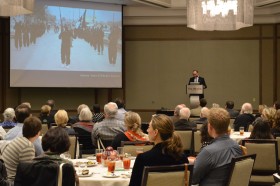
On November 23rd, the Syrian Heritage Initiative hosted a public Symposium at theASOR Annual Meeting in San Diego, CA. The more than 80 attendees included ASOR members, representatives of other groups […]